

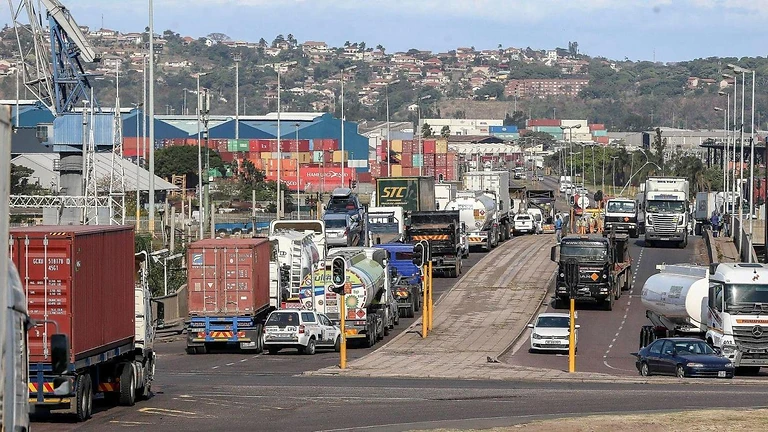
Congestion-related charges and alleged anti-competitive practices by shipping lines are threatening the survival of independent container transporters using Durban Gateway Terminal (DGT), according to the Positive Freight Solutions Container Transport Association (PFS).
Terminal delays outside transporters’ control were placing businesses under sustained financial pressure, PFS chairperson Aven Naidu told the UnBlocked: Focus on Freight event hosted by Let’sFixSA in Durban on Thursday.
Transporters and industry representatives discussed ways to improve terminal operations and coordination between the private sector, terminal management and government. Panellists included South African Association of Freight Forwarders (SAAFF) CEO Juanita Maree and Otto1890 Securities economist and portfolio manager Mohil Bandulal.
An explainer video prepared by PFS alleged that terminal bottlenecks had become revenue sources for shipping lines through demurrage, detention and congestion charges.
Shipping lines continued to levy dollar-denominated demurrage and detention charges despite the terminal acknowledging delays beyond customers’ control and waiving its own storage charges, according to the presentation. It also cited a congestion destination fee of up to $500 (approximately R8 300) associated with DGT.
“Instead of fixing the equipment crisis or working with local operators to ease the backlog, the shipping line simply put a price tag on the terminal's congestion, guaranteeing themselves an entirely new stream of income directly derived from the bottleneck,” the PFS presentation alleged.
“This completely changes the math of global shipping because one systemic failure at the terminal now pays out three times to the shipping lines. They get demurrage, they get detention, and now they get this congestion destination fee.”
PFS further alleged that shipping lines approached cargo owners facing accumulated charges and offered to waive those fees if they switched from independent transporters to the lines’ own transport services.
A formal complaint concerning the alleged conduct had been lodged with the Competition Commission, Naidu said.
“These shipping lines are not South African companies; they are foreign entities billing us in dollars, taking away South African money to foreign countries, and they're removing money from our fiscus, all at their behest, and they are profiteering at our cost,” he said.
“We will not be pushed out of the industry. We will not be silenced, and we will not be told how our businesses should be run by foreign companies.”
MSC has previously disputed the allegations, saying demurrage is not charged to trucking companies or independent hauliers. Maersk South Africa, CMA CGM, Hapag-Lloyd, ONE, COSCO, Pacific International Lines and Evergreen had not commented at the time of writing.
Operational failures carry wider costs
An analysis of terminal records for the first half of 2026 cited during the discussion indicated that 60.8% of truck appointments were unused, which the presentation attributed to coordination failures between landside and waterside operations.
The analysis also covered more than 58 000 truck appointments. Of these, 44.8% missed the terminal’s 90-minute turnaround target, while almost 12% of visits lasted more than four hours.
The economic consequences extended beyond the transport sector to retailers and manufacturers, Bandulal said.
“A peer-reviewed Stellenbosch University study estimates that port failures alone cost our economy about R46 billion in 2022, around just under 1% – to be more precise, 0.7% – of GDP. When we are under 1% of GDP growth, 0.7% is a big number.”
“These are not merely trucking problems; they are national problems, and they transmit through the economy,” he said.
Restoring terminal fluidity was urgent, with DGT’s performance adding substantial time to supply chains, Maree said.
“We add, with the Durban Gateway Terminal performance, 21 to 22 days to the supply chain,” she said.
Greater transparency about the extent of the disruption was necessary to secure meaningful improvements.
“Unless we are brutally honest with each other, and we try for radical transparency, we're not going to change what we've got,” Maree said.
Road, rail, sea and air transport needed to function as parts of an integrated system, she said. Removing rail capacity distorted the wider supply chain.
“We're in a shared logistics network, and if we don't work together, what is the ultimate effect? It's waste and constriction, and waste and constriction are what kills the economy.”
Performance measures and an integrated logistics plan were needed to reduce costs and connect port operations with inland corridors and manufacturing centres, Maree said.
Durban needed to function effectively as a gateway to the central and Gauteng corridors, while planning should also consider the Eastern Cape’s potential role as a transhipment hub and its connections with Durban and the Western Cape.
Government intervention sought
Assistance with rising fuel costs, toll fees and municipal fines was also needed, Naidu said, appealing to Ntuli for greater recognition of transporters and their inclusion in logistics planning.
Rail underperformance along the Durban-Gauteng and Durban-Richards Bay corridors had cost the South African economy an estimated R276bn in 2023, largely because cargo was forced onto roads, Ntuli told the gathering.
“The government does not see logistics as merely a technical necessity, but as a nucleus of activities without which we would perish. It is the bridge that connects our people to opportunities, our rural communities to urban centres, and our local industries to global markets.”
The provincial government would facilitate dialogue between logistics stakeholders, Transnet and national departments, Ntuli said. He committed to escalating the industry’s grievances to the deputy minister of transport Mkhuleko Hlengwa.
DGT responds on systems and bookings
Vessel waiting times had averaged 8.3 days at the peak of disruption following the transition to the Navis N4 terminal operating system, DGT CEO Javier Lancha said during a media briefing on Friday.
Management was working to restore fluidity, and the system was operational, he said.
“Navis is fully functional, and it was successfully implemented in three months,” Lancha said.
Structural changes took time because the transition involved changes to processes and technology transfer as well as the core system, he said.
Responding to transporters’ frustration over booking availability, Lancha said DGT planned to replace its current truck appointment system with a modernised digital framework.
“The truck appointment system, as it's perceived today, will be renewed and completely changed,” he said.
The proposed system would address the current booking challenges, Lancha said.

















Comments (0)