
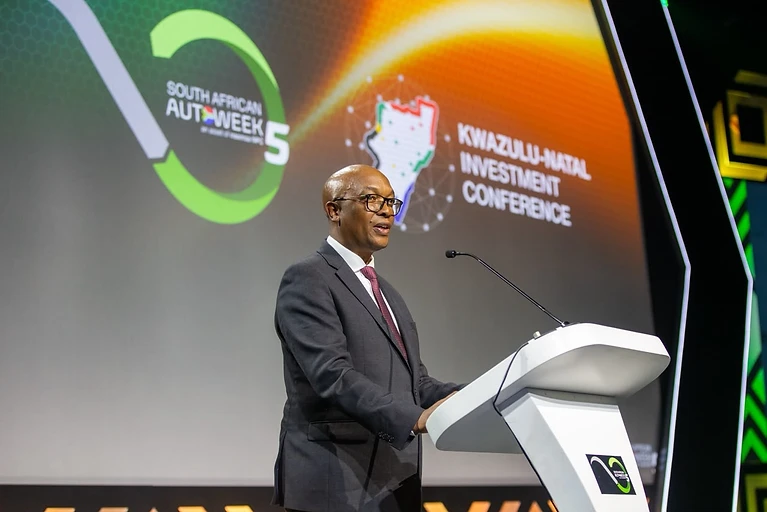
South Africa plans to phase out existing semi-knock-down (SKD) vehicle assembly operations and stop providing policy support for new SKD facilities, Trade, Industry and Competition Minister Parks Tau announced at South African Auto Week in Durban on October 15.
Medium and heavy commercial vehicles would be excluded from the change, he said in an address delivered on behalf of President Cyril Ramaphosa.
SKD operations involve assembling vehicles from imported kits containing largely pre-assembled components. Government also planned to strengthen the legal definitions of completely-knock-down (CKD) manufacturing, Tau said.
The Department of Trade, Industry and Competition’s statement did not specify a timetable for the phase-out.
The decision formed part of government’s review of the Automotive Production and Development Programme Phase 2 (APDP2), undertaken with naamsa, the National Association of Automotive Component and Allied Manufacturers (Naacam) and organised labour, the department said.
An APDP modelling study had examined potential short-term interventions to improve domestic vehicle manufacturers’ competitiveness relative to importers of fully built vehicles, government news agency SAnews reported.
Proposals included reviewing the ad valorem tax structure to differentiate more clearly between locally produced and imported vehicles, potentially through changes to the tax base and local adjustment factor, the news agency reported, citing the department.
Other measures under consideration included addressing imbalances in the operation and accumulation of Production Rebate Certificates and revising Volume Assembly Local Allowance parameters to better align incentives with industrial policy objectives, the report said.
The broader South African Automotive Master Plan targeted local content of 60%, double industry employment and a 1% share of global vehicle production by 2035, Reuters reported.
The competitiveness of South Africa’s ladder-frame light commercial vehicle segment, which includes bakkies, would also be investigated by the International Trade Administration Commission of South Africa (ITAC), Tau said.
“We have agreed that the strategic competitiveness of South Africa’s ladder frame LCV segment warrants formal investigation,” he said.
Any additional protection should be accompanied by commitments relating to production, localisation, employment, transformation, exports and investment, Tau said. He will instruct ITAC to undertake the investigation before a final determination is made.
South Africa also needed to adapt vehicle production to changing demand in export markets such as Europe and the United Kingdom or risk losing those markets and associated manufacturing jobs, he warned.
Work had begun on an end-of-life vehicle policy as part of the decarbonisation pathway in government’s Industrial Development Strategy, Tau said. Battery recycling and second-life applications offered opportunities to develop a new domestic industry, he added.




















Comments (0)